Peer Review Process
Figure 1. Peer Review Process of DISTINCTION: Journal of Communication and Society.
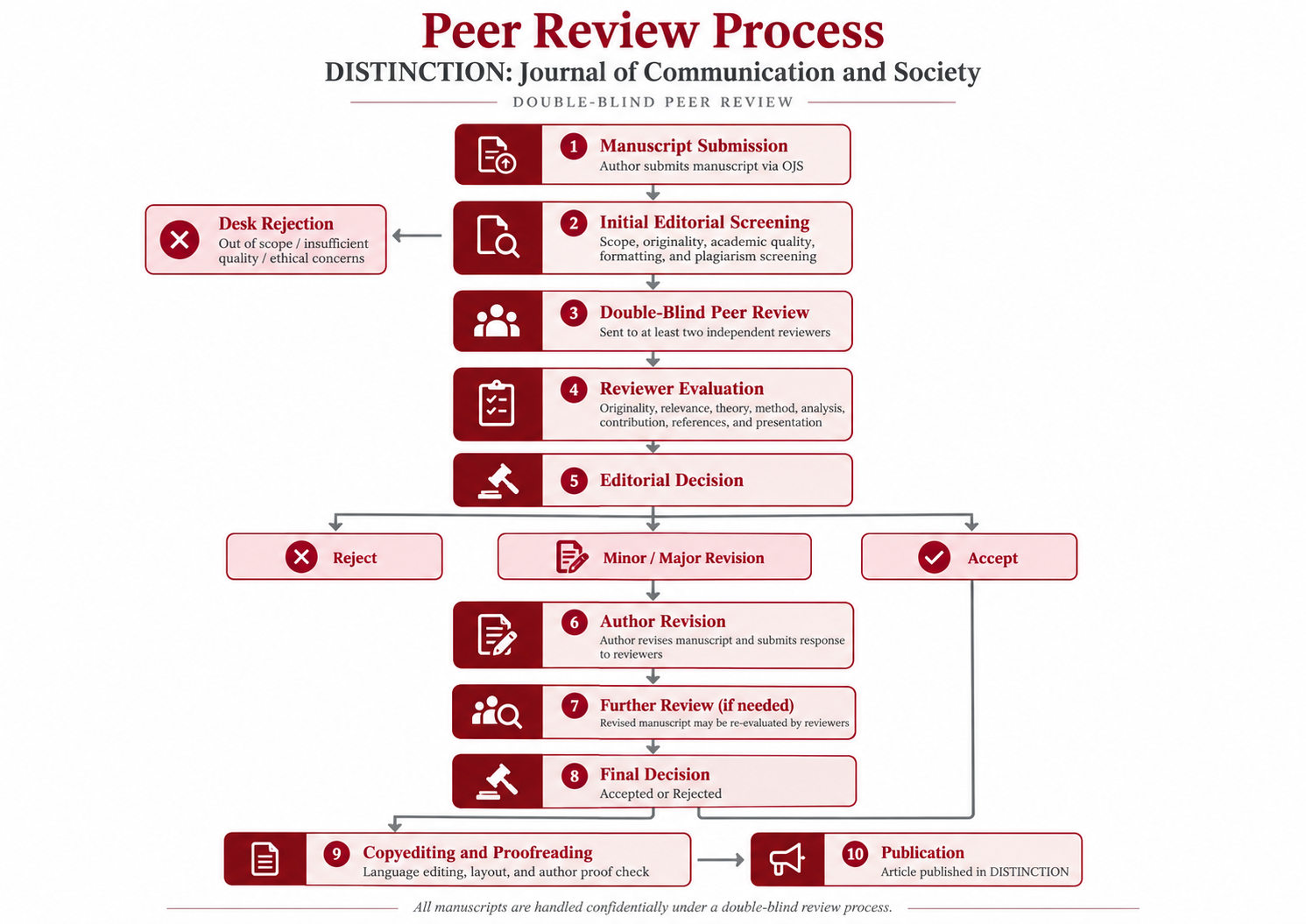
DISTINCTION: Journal of Communication and Society applies a rigorous peer-review process to ensure the academic quality, originality, relevance, and integrity of all manuscripts considered for publication.
All research articles, review articles, and conceptual papers submitted to DISTINCTION are subject to editorial screening and, when considered suitable, independent peer review.
1. Initial Editorial Screening
All submitted manuscripts are first evaluated by the editorial team before being sent for peer review.
During this initial screening, the editors assess:
- Relevance to the Focus and Scope of DISTINCTION;
- Originality and academic contribution;
- Clarity of research objectives or scholarly arguments;
- Appropriateness of research methods or conceptual approach;
- Compliance with the Author Guidelines;
- Quality of academic writing;
- Ethical and publication integrity requirements;
- Results of plagiarism or similarity screening.
Manuscripts that clearly fall outside the journal's scope, do not meet minimum academic standards, contain serious ethical concerns, or fail to comply substantially with the journal's requirements may be rejected without external peer review.
2. Peer Review Model
DISTINCTION uses a double-blind peer review model.
Under this model:
- The identity of the author(s) is not disclosed to the reviewers;
- The identity of the reviewers is not disclosed to the author(s).
Authors are therefore responsible for preparing manuscripts in a manner that does not reveal their identity during the review process.
3. Reviewer Selection
Manuscripts that pass the initial editorial screening will normally be evaluated by at least two independent reviewers with relevant expertise in the subject area of the manuscript.
Reviewers are selected based on their academic expertise, research experience, publication record, and ability to provide an objective and constructive evaluation.
Editors will seek to avoid appointing reviewers who have known conflicts of interest with the authors or the research under consideration.
4. Reviewer Responsibilities
Reviewers are expected to evaluate manuscripts objectively, constructively, confidentially, and within the agreed review period.
Reviewers should assess, where relevant:
- Originality and significance of the manuscript;
- Relevance to communication and society;
- Clarity of the research problem or scholarly argument;
- Quality and adequacy of the literature review;
- Appropriateness of the theoretical or conceptual framework;
- Appropriateness and rigor of the methodology;
- Quality of analysis and interpretation;
- Relationship between findings, discussion, and conclusions;
- Academic contribution of the manuscript;
- Quality and relevance of references;
- Clarity, coherence, and academic presentation.
5. Review Period
Reviewers are generally expected to complete their evaluation within approximately 2–4 weeks after accepting the review invitation.
The actual review period may vary depending on reviewer availability, manuscript complexity, and the need for additional review.
6. Reviewer Recommendations
After evaluating a manuscript, reviewers may recommend one of the following:
- Accept Submission – the manuscript may be accepted without substantial revision;
- Minor Revision – the manuscript requires limited revisions before it can be considered for acceptance;
- Major Revision – substantial revisions are required and the manuscript may need to undergo further review;
- Resubmit for Review – the manuscript requires significant changes and should be evaluated again as a substantially revised submission;
- Decline Submission – the manuscript is not suitable for publication in its current form or does not meet the journal's academic standards.
Reviewer recommendations are advisory. The final editorial decision is made by the Editor or Editor-in-Chief based on reviewer reports, the quality of the manuscript, and the journal's editorial policies.
7. Editorial Decision
After receiving the reviewer reports, the editor evaluates the recommendations and determines the appropriate editorial decision.
Possible decisions include:
- Accepted;
- Minor Revision;
- Major Revision;
- Resubmit for Review;
- Rejected.
When reviewer recommendations differ substantially, the editor may:
- Assess the reports and make an editorial decision based on the academic arguments provided;
- Request clarification from the reviewers;
- Invite an additional reviewer to evaluate the manuscript.
8. Revision Process
When revisions are requested, authors are expected to carefully address the comments and recommendations provided by reviewers and editors.
Authors should submit:
- A revised version of the manuscript; and
- A detailed response to reviewers explaining how each comment has been addressed.
If an author chooses not to follow a particular reviewer recommendation, a clear academic justification should be provided.
The revised manuscript may be returned to the original reviewers when major revisions are required or when the editor considers additional evaluation necessary.
9. Final Decision
The final decision regarding publication rests with the Editor-in-Chief or the editor responsible for the manuscript.
Acceptance is based on the manuscript's academic quality, originality, relevance, methodological or conceptual rigor, ethical compliance, and contribution to the field of communication and society.
10. Confidentiality
All manuscripts submitted to DISTINCTION are treated as confidential documents.
Editors and reviewers must not disclose, discuss, reproduce, distribute, or use information contained in a manuscript for personal or professional advantage before publication.
Reviewer reports and editorial correspondence are also treated as confidential unless disclosure is required for ethical, legal, or publication-integrity reasons.
11. Conflict of Interest
Editors and reviewers must disclose any potential conflict of interest that could affect, or reasonably be perceived to affect, their objectivity.
Potential conflicts may include personal, professional, financial, academic, institutional, or collaborative relationships with the authors or the research.
Reviewers who identify a significant conflict of interest should decline the review invitation.
12. Ethical Concerns During Peer Review
If reviewers or editors identify suspected plagiarism, data fabrication, data falsification, duplicate publication, citation manipulation, unethical research practices, or other forms of research or publication misconduct, the matter will be handled in accordance with the journal's Publication Ethics.
The peer-review process may be suspended while ethical concerns are investigated.
13. Use of Generative Artificial Intelligence in Peer Review
Editors and reviewers must ensure that the use of generative artificial intelligence or AI-assisted technologies does not compromise the confidentiality, integrity, intellectual property, or independence of the peer-review process.
Unpublished manuscripts and other confidential editorial materials must be handled in accordance with the journal's Policy on the Use of Generative AI .
Editors and reviewers remain fully responsible for the accuracy, fairness, confidentiality, and scholarly integrity of their editorial or review assessments.
14. Reviewer Conduct
Review comments should be professional, respectful, constructive, and focused on the scholarly quality of the manuscript.
Personal criticism, discriminatory language, hostile comments, or inappropriate demands are not acceptable.
Reviewers should not request unnecessary citations to their own work, to a particular journal, or to other publications unless those references are genuinely relevant to improving the manuscript.
15. Editorial Independence
Editorial decisions are based on scholarly considerations and are made independently of commercial, institutional, personal, or other external interests.
The publisher does not determine whether an individual manuscript is accepted or rejected on non-academic grounds.
16. Appeals
Authors may appeal an editorial decision when they believe that a significant error has occurred in the evaluation or decision-making process.
An appeal should provide a clear academic explanation and specifically address the reasons stated in the editorial decision.
Appeals that merely express disagreement with reviewer comments without providing substantive academic justification may not be reconsidered.
The handling editor or Editor-in-Chief may review the appeal, consult another editor, or seek an additional independent assessment where appropriate.
17. Review of Manuscripts Submitted by Editors or Editorial Board Members
Manuscripts submitted by editors, editorial board members, or individuals closely associated with DISTINCTION will be handled through an independent editorial process.
The submitting editor or board member will not participate in reviewer selection, access confidential reviewer identities, or make the final editorial decision regarding their own manuscript.
18. Peer Review Integrity
DISTINCTION is committed to maintaining the integrity and independence of the peer-review process.
Any attempt to manipulate peer review, including the use of fabricated reviewer identities, false contact information, undisclosed conflicts of interest, inappropriate reviewer suggestions, or coordinated review manipulation, may result in rejection of the manuscript and further action under the journal's Publication Ethics.
19. Estimated Publication Process
The journal aims to manage manuscripts efficiently while maintaining academic quality. However, the total time from submission to final decision may vary depending on editorial screening, reviewer availability, the number of revision rounds, and the complexity of the manuscript.
Authors are encouraged to respond to editorial and reviewer requests promptly in order to support an efficient publication process.